
Mastering the Spear with These Javelin Training Secrets
Why Javelin Throw Training Demands Speed, Power, and Precision
Javelin throw training is the structured practice of developing the technique, strength, and speed needed to hurl a spear-like implement as far as possible — legally and safely.
Here is a quick overview of what effective javelin training covers:
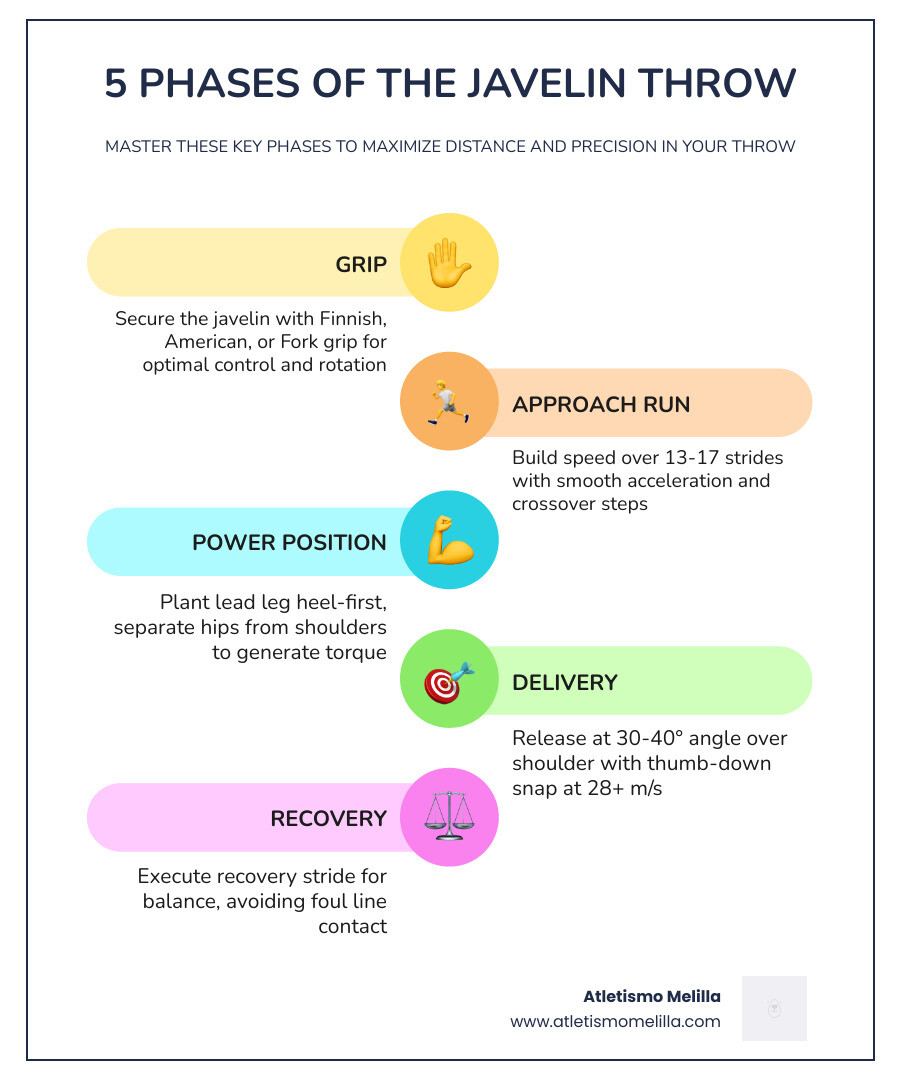
- Grip — Choose from the Finnish, American, or Fork grip based on comfort and control
- Approach run — Build controlled speed over 13-17 strides before releasing
- Power position — Plant the lead leg, separate hips from shoulders, and load explosive force
- Release — Launch at 30-40 degrees over the shoulder with a thumb-down snap
- Strength and drills — Train like a sprinter or jumper, not a powerlifter
Unlike shot put or discus, the javelin throw is a speed-power event. The athlete who throws furthest is rarely the biggest — they are the fastest and most technically precise. Top male throwers release the javelin at over 28 meters per second. That kind of velocity comes from years of deliberate, well-structured training.
The javelin is also deceptively technical. A small flaw in your grip, your crossover steps, or your release angle can cost you meters — or worse, cause injury. That is why understanding each phase of the throw matters just as much as how hard you train.
Whether you are picking up a javelin for the first time or looking to sharpen your existing mechanics, this guide breaks down everything you need to know — from grip selection to weekly training plans.
The Fundamentals of Javelin Throw Training
At Atletismo Melilla, we believe that excellence begins with a solid foundation. Before you even step onto the runway in April 2026, you must understand the tool in your hand. The javelin is a highly tuned aerodynamic instrument designed to fly, but it only does so when handled with respect for its center of gravity and corded binding.
To begin your javelin throw training, you’ll need the following essential equipment:
- The Javelin: A standard men’s javelin weighs 800 grams and measures 2.6 to 2.7 meters. For women, the standard is 600 grams and 2.2 to 2.3 meters.
- The Training Area: A runway for the approach and a 29-degree sector where the javelin must land to be considered a legal throw.
- Footwear: Specialized throwing boots with spikes on both the toe and heel to provide grip during the high-speed approach and the sudden “block” at the end.
Understanding How To Throw A Javelin starts with recognizing that release velocity is the number one factor in distance. Top female throwers reach speeds over 25 m/s, while elite males exceed 28 m/s. Every piece of gear and every fundamental movement is designed to maximize this velocity.
Choosing the Right Grip for Javelin Throw Training
The first step in any throwing session is securing the implement. We recommend trying all three primary grips to see which offers you the best blend of rotation and control. Regardless of which you choose, your hand should remain relaxed—never a “clenched fist of death”—until the moment of the strike.
- The American Grip: You place your thumb and the first joint of the index finger behind the cord. It offers great control and high rotation but can occasionally put more stress on the elbow.
- The Finnish Grip: This is the most common grip among elites. The thumb and the first two joints of the middle finger go behind the cord, with the index finger extended along the shaft for stability. It is often considered safer for the elbow while providing excellent rotation.
- The Fork (or V) Grip: The javelin is held between the index and middle fingers. This is a fantastic choice for beginners because it promotes a natural “over-the-top” release, though it typically generates less rotation than the other two.
Official Specifications and Gear
As of April 2026, javelin specifications remain strict to ensure fair competition. Beyond the weight of the spear, your personal gear plays a massive role in safety. Non-restrictive athletic clothing is vital to allow for the massive thoracic opening required in the power position.
We always emphasize using a safe, designated throwing area. Because the javelin is an aerodynamic spear, it should never be thrown in public parks or unsupervised spaces. Proper throwing boots are non-negotiable for serious athletes; the heel spikes allow you to plant your lead leg firmly without slipping, which is essential for transferring momentum from your run into the throw.
Mastering the Technical Phases: From Approach to Release
The javelin throw is a symphony of movement. It isn’t a standstill event; it’s a sprint that transitions into a launch. Most advanced throwers use an approach of 14 or more strides, while beginners should start with 5 to 8 to master the rhythm.
The approach run usually covers 13 to 17 strides. We focus on smooth, controlled acceleration rather than an all-out sprint. If you run too fast to maintain your technique, your distance will suffer. As you move through the run, you will transition into the “withdrawal,” where the javelin is pulled back. This typically happens when two to four left-foot contacts remain in the full approach.
Developing a How to Improve Your Javelin Throwing Technique requires mastering the “rhythm of five.” This is the final sequence of steps—left, right, left, right, throw—that sets up the launch. Many athletes use mental counting to stay in rhythm during this high-speed transition.
The Power Position and Blocking Action
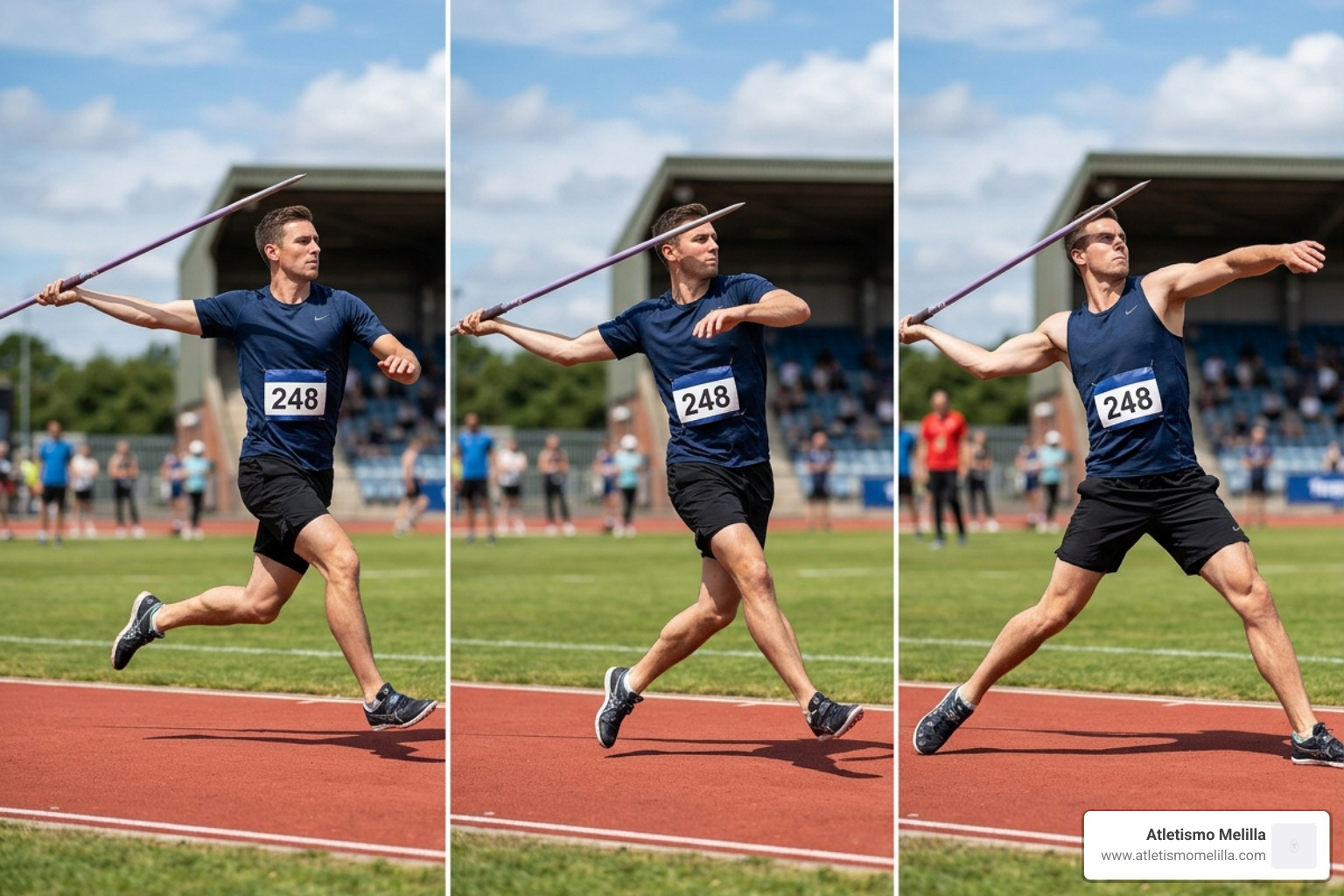
The “Power Position” is the most critical moment of the throw. It occurs after the crossover steps when your right foot plants on the ball of the foot at a 30 to 45-degree angle. Immediately after, the left leg plants firmly—heel first—in a “blocking” action.
This block is like hitting the brakes in a car; the lower body stops, forcing the upper body to whip forward. This creates massive torque and hip-to-shoulder separation. Think of your body as a giant rubber band being stretched to its limit before being snapped forward. This kinetic chain is what allows an 800g javelin to reach those 28 m/s velocities.
Delivery and Follow-Through Mechanics
Once the block is set, the delivery begins. The javelin must be thrown over the shoulder or upper arm. The arm should be fully extended, and the hand rotates into a “thumb-down” position upon release to ensure the javelin flies through its point.
The optimal release angle is generally between 30 and 40 degrees. If you release too high, the javelin catches the wind and stalls; too low, and it hits the ground too early. After the release, you must perform a recovery stride to stay behind the foul line. The javelin should be released approximately one javelin length away from the line to give yourself room to decelerate safely.
Strength, Speed, and Specialized Drills
Javelin throwers are speed-power athletes. We don’t just lift heavy; we lift fast. Training involves a mix of sprint mechanics, plyometrics, and specialized throwing drills.
| Training Phase | Focus Areas | Key Exercises |
|---|---|---|
| Off-Season | General Strength & Mobility | Squats, Deadlifts, Yoga, General Med Ball Throws |
| Pre-Season | Explosive Power | Power Cleans, Sprints, Turbo Javelin Drills |
| In-Season | Technique & Speed | Full Approach Throws, Video Analysis, Plyometrics |
We often use specialized tools like Turbo Javelins for beginners to learn how to throw “through the point.” Nockenballs and heavy throwing balls are excellent for building arm speed and specific strength, while the Javee device helps athletes isolate movements and feel the correct resistance throughout the throwing motion.
Periodization in Javelin Throw Training
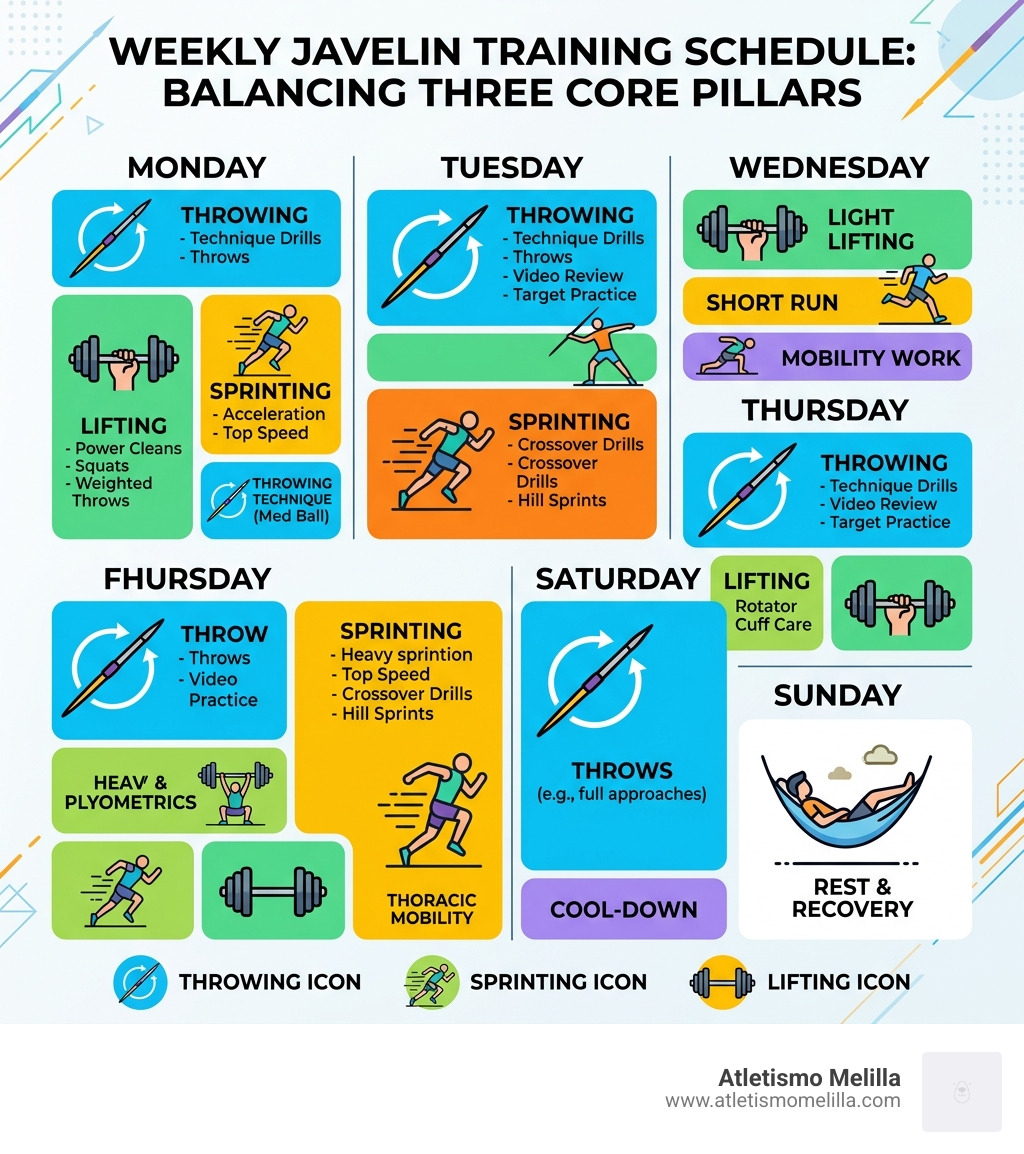
A typical mid-season javelin throw training session is high intensity. We might start with 8 full approach runs and 8 thirty-meter sprints to keep the legs “snappy.” Strength work includes power cleans (6 sets of 3 reps) and dumbbell shoulder presses to build the explosive “strike” needed at the finish.
However, we never neglect the small muscles. Rotator cuff care and thoracic mobility are daily requirements. If your mid-back is tight, you cannot achieve the necessary lay-back position, which puts dangerous stress on your elbow and shoulder.
Event-Specific Warm-Up Routines
Never throw for maximum effort when your body is cold. Our warm-up routine usually begins with a 400m jog followed by dynamic stretching—arm circles, leg swings, and trunk rotations.
Specific drills include:
- Walking Three-Step Throws: Focuses on the final rhythm without the speed of the full run.
- Kneeling Two-Handed Throws: Isolates the core and upper body.
- High Right Knee Drives: Mimics the crossover step to build muscle memory for the transition phase.
Frequently Asked Questions about Javelin Training
What is the most important part of the javelin throw?
While every phase matters, the transition from the run-up to the power position (the crossover steps) is arguably the most vital. This is where you convert horizontal speed into vertical and horizontal throwing power. If the transition is clunky, you lose all the momentum you built during your approach.
How do I fix a javelin that lands flat or “wobbles”?
A flat landing usually means your release angle was too low or you “pulled” the javelin down rather than throwing it up and through. A “wobble” occurs when you apply force “around” the shaft rather than directly through the center of gravity. Using video feedback is the best way to see if your hand is staying behind the javelin or sliding to the side.
What are the most common foul rules to avoid?
To keep your throws legal:
- Do not turn your back completely to the sector until the javelin has landed.
- The javelin must land within the 29-degree sector lines.
- The metal tip must hit the ground first (it doesn’t have to stick, but it must touch first).
- You must not touch the foul line or the ground beyond it at any point during or after the throw.
- The javelin must be thrown over the shoulder; sidearm throws are illegal and dangerous.
Conclusion
At Atletismo Melilla, we are dedicated to helping you reach your peak in April 2026 and beyond. Mastering the javelin is a journey of patience. It requires the heart of a sprinter and the precision of an archer.
Beyond the technical drills, recovery is where the gains happen. Prioritize 7–9 hours of sleep per night for muscle recovery and maintain a nutrition plan rich in protein and complex carbohydrates. Mental preparation—visualizing the perfect flight and the satisfying “thud” of a clean stick—is just as important as the physical work.
Are you ready to unlock your potential? Start your athletic journey with us today and transform your speed and power into record-breaking distances. Let’s make this season your best one yet!
